
The AI boom is often framed as a race for bigger models and faster chips, but the real bottleneck is far more basic: power. AI runs on compute, compute runs on electricity, and electricity is constrained by grids, permitting, and infrastructure that move at government speed. As demand for AI data centers explodes, delays in transmission, interconnection, and approvals are shaping where and how AI can scale—sometimes pushing capital to consider extreme alternatives like space-based compute. The takeaway for governments is clear: responsible AI leadership is no longer just about policy.


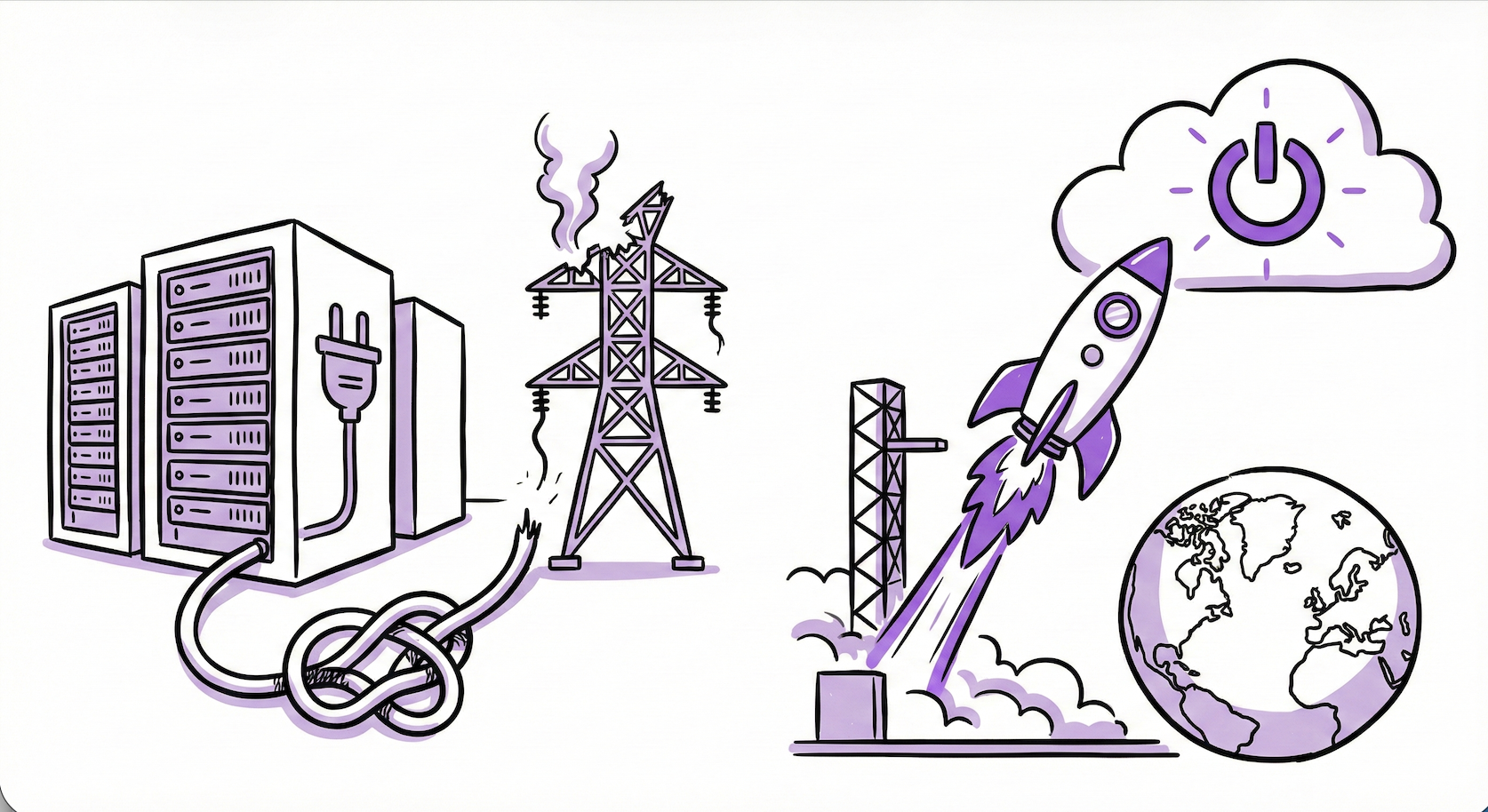
The next global resource war won’t be over oil, lithium, or even chips. It will be over something more boring, more fundamental, and far harder to scale quickly: places where electrons are allowed to flow. The AI boom is usually framed as a software story. Bigger models, smarter agents, synthetic coworkers. But beneath the abstractions is an old-fashioned constraint problem. AI runs on compute. Compute runs on electricity. Electricity runs through wires. And wires run into permitting offices, environmental reviews, local politics, and timelines that move at government speed.
This is the quiet bottleneck shaping the next decade of technology. The growing conversation about Elon Musk and Jeff Bezos racing to put AI data centers in space captures the headline version of this story, but it misses the deeper truth. Earth did not suddenly run out of power. It ran out of patience, coordination, and physical slack. We have electrons. What we don’t have is the ability to move them quickly to where demand is exploding.
Nowhere is this clearer than Northern Virginia, which hosts the largest concentration of data centers on the planet. New hyperscale facilities there routinely face power interconnection timelines measured not in months, but in years. Not because generation is unavailable, but because transmission upgrades, substations, and approvals lag far behind demand. A single modern AI data center can require 100 to 500 megawatts of power, roughly the equivalent of powering a mid-sized city. Multiply that by dozens of facilities coming online at once, and the constraint becomes obvious.
This friction is not unique to Virginia. Europe faces grid saturation and regulatory drag. Asia faces land scarcity. Even regions with abundant renewable energy struggle to connect new loads fast enough. The result is a global mismatch between where compute is needed and where power can be delivered on useful timelines.
That gap is where Musk and Bezos operate. Not because space is romantic, but because it is, perversely, simpler. No local utility commission. No seven-year wait for a transmission line. No zoning appeals. From orbit, solar panels collect energy nearly continuously, unbroken by night cycles or weather, and no one files an injunction against sunlight. Space begins to look less like science fiction and more like a workaround for terrestrial paralysis.
Ten years ago, this would have sounded like the ramblings of a lunatic. Launching a single kilogram of payload into space used to cost around $60,000 on the Space Shuttle. At those prices, putting a single server rack in orbit would cost more than the GDP of a small nation.
But this is where the people who insist innovation has stalled miss the story. SpaceX’s Falcon 9 drove launch costs down to roughly $2,700 per kilogram. That alone was a step change. Starship, the fully reusable behemoth currently being stress-tested on the Texas coastline, is designed to push that number below $100 per kilogram. If it succeeds even partially, it does not just lower costs. It changes the class of problems that can be contemplated.
And it’s not just rockets getting reinvented. Some of the most interesting work is happening well before launch ever begins. My friend Shahar Bahiri is co-founder and COO of Moonshot Space, an Israeli startup that recently came out of stealth with a radically different approach to getting payloads off the planet. Instead of strapping computers or satellite parts to a tower of explosive fuel, Moonshot is building a ground-based electromagnetic accelerator, essentially a massive electrified launch tube that can sling hardened payloads to hypersonic speeds using electricity rather than burning tons of propellant. The technical ambition is striking, but the economic implication is even more important. In a traditional rocket, roughly 96 percent of the mass you launch is fuel and structure, and only about 4 percent is the thing you actually care about. Moonshot’s goal is to flip that equation, pushing the useful payload share toward 45 percent. In practical terms, that means far more of what you pay to launch ends up in orbit doing real work, dramatically lowering cost per delivered kilogram and making frequent, high-volume resupply far more realistic. Early commercial interest from in-orbit servicing companies like D-Orbit and Orbit Fab suggests this isn’t just theoretical. If it works, it doesn’t just make launches cheaper. It changes the economics of operating in space altogether.
Musk’s advantage here is structural. SpaceX builds the rockets. Starlink provides a global communications backbone already operating at scale. And xAI sits downstream as a compute-hungry customer. It is vertical integration applied to infrastructure, not consumer products. Bezos understands this logic intuitively. Amazon was never just a retailer. It was a logistics machine disguised as a bookstore. Blue Origin is his long-term bet that the next logistics frontier is above the atmosphere, even if he is still catching up.
Still, this is not a clean or inevitable story. The physics are unforgiving. Cooling computers in space is far harder than popular narratives suggest. On Earth, data centers rely on air, water, and evaporation. In space, heat can only be shed through radiation, which is slow and requires massive surface area. The International Space Station, which consumes roughly 75 to 90 kilowatts of power, already relies on enormous radiator panels. A true AI data center would need orders of magnitude more cooling capacity, and nobody has yet demonstrated how to build or deploy radiators at that scale.
Radiation is another problem. Cosmic rays and solar particles degrade electronics over time, forcing tradeoffs between durability and performance. Chips designed to survive in orbit are typically slower and more expensive. When Nvidia’s CEO dismisses space-based data centers as a dream, it is not cynicism. It is an acknowledgment that the engineering hurdles are real.
This is not happening next year. Probably not the year after that either. Most credible timelines point to experimental systems later this decade, with any meaningful scale pushed into the 2030s. But timing is not the point. The point is that the most capable builders in the world are no longer assuming that Earth will get its act together fast enough.
That should worry policymakers. The real race is not Musk versus Bezos or Starship versus New Glenn. It is a race between two futures. One where governments modernize grids, accelerate permitting, and treat power infrastructure as strategic rather than procedural. Another where capital increasingly routes around dysfunction by leaving the planet.
There is deep irony here. AI is supposed to make systems more efficient. Instead, its rise is exposing just how inefficient our physical systems have become. Governments talk endlessly about digital transformation while taking a decade to approve a transmission line. We celebrate breakthroughs in models while ignoring that the bottleneck is often a substation or a right-of-way.
Space becomes attractive not because it is easy, but because Earth has made the hard things harder than they need to be.
In the near term, most AI compute will stay grounded, close to users, close to fiber, close to water. But in the long term, the signal is clear. If we do not radically speed up how we build power infrastructure on Earth, capital will keep looking for exits. Space is one of them.
The AI boom is not hitting a wall. Rather, it is showing us that our limiting factor is no longer imagination or capital, but execution. And when execution fails at scale, even the most Earth-bound industries start looking up.

.svg)
.png)
.png)