Official surveys put AI use in local health departments at 5%. Ask the staff and it is closer to 75% here is the plain-language literacy and the five guardrails that close the gap.


.svg)
.png)
Whether or not your board has approved it, budgeted for it, or written a policy about it, staff in your health department are using AI this week.
The official numbers say otherwise. In NACCHO's 2024 Public Health Informatics Profile, only 5% of local health departments reported currently using AI or machine learning, and most reported no plans to start within the year.
Ask the staff instead and the picture inverts. In the survey behind NACo's AI County Compass, more than 75% of county officials and staff reported using generative AI tools at work and at home. That figure comes from a membership survey, so it skews toward the technology-engaged end of county government — but it is not 5%.
The gap between those two numbers is the governance problem. And the reason it stays hidden is well documented: in a study of more than 48,000 people across 47 countries by the University of Melbourne and KPMG, 57% of employees said they hide their AI use and present AI-generated work as their own.
This is not a story about bad actors. It is a good employee, a free account, and a Tuesday deadline.
The same study found that 66% of people rely on AI output without evaluating its accuracy, and 56% report having made mistakes in their work because of AI. That is the actual exposure — not malice, but unverified output moving into public-facing work.
Three things close the gap: plain-language literacy, clear categories, and guardrails staff can follow without a lawyer in the room.
A large language model predicts plausible next words based on patterns in its training data. It is optimized for fluency, not accuracy. That is why it drafts clean prose and also produces citations that do not exist, statutes that were never passed, and case details no one recorded.
Think of it as a fast, confident new analyst whose work has never once been fact-checked.
Give it: first drafts of memos, technical clinical guidance rewritten at a sixth-grade reading level, public advisories translated into Spanish, and 60-page grant guidance condensed into a summary.
Never give it: the role of system of record, arithmetic or case counts, or sign-off on an official public health action.
The level of supervision a tool needs depends on how much it does on its own.
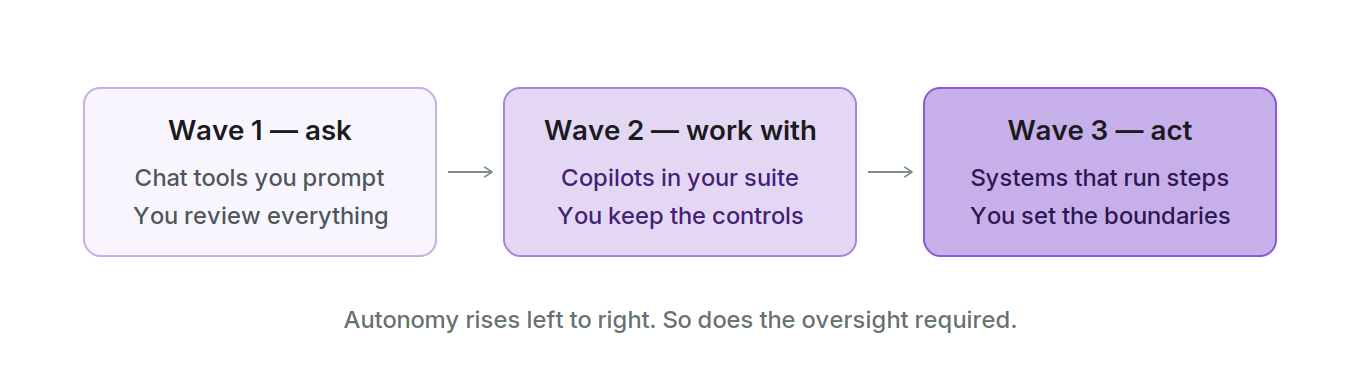
Wave 1 — ask. Chat interfaces you prompt directly. You ask, it drafts, you check everything before it leaves your desk.
Wave 2 — work with. AI inside the software your staff already use, like Microsoft 365 or Google Workspace. It works alongside the user, who keeps direct control of the document.
Wave 3 — act. Systems that execute multi-step work, move between applications, and take action inside boundaries you set in advance.
Most departments are somewhere between Wave 1 and Wave 2 right now, often without having decided to be. Wave 3 is where the approval question stops being theoretical, because the human is no longer in the loop by default — they are in the loop only if you designed them into it.
You do not need a policy binder to start reducing risk. Five rules cover most of the exposure, and staff can apply them today.
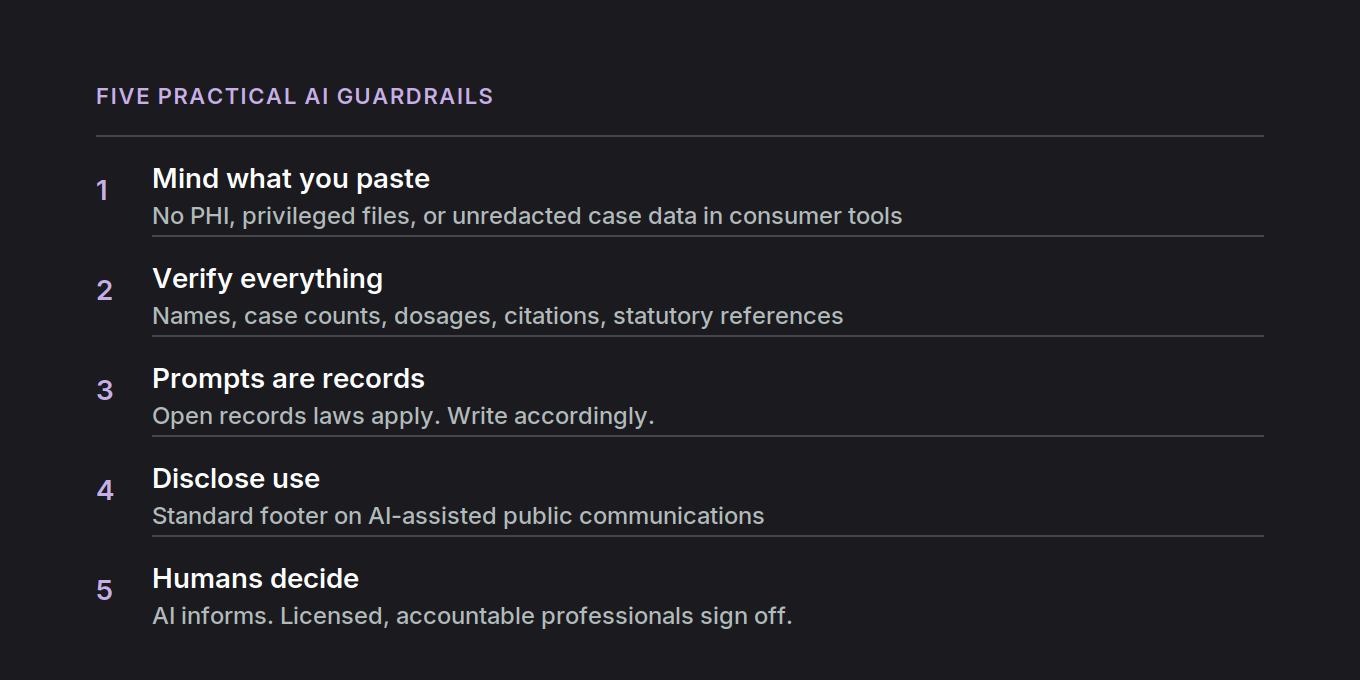
Mind what you paste. No protected health information, privileged legal files, or unredacted case data goes into a consumer AI account. Free tools do not come with a Business Associate Agreement.
Verify everything. Every name, case count, dosage, citation, and statutory reference gets checked by a person against the source.
Prompts are records. In public agencies, what staff type into an AI tool during public business can be a public record. Write every prompt as though it may be read aloud later.
Disclose use. When AI helped draft a public communication, say so with a standard footer. Deciding the wording once, centrally, is easier than defending an inconsistent practice later.
Humans decide. AI informs the work. A licensed, accountable professional signs it.
Vague prompts produce confident, useless output. A structured prompt does most of the quality control before the model starts writing.
Role. "You are a health communications specialist for a local health department."
Context. "The county is issuing a boil water advisory after a main break in District 4."
Task. "Rewrite the attached engineering report as a public advisory notice."
Format. "Under 150 words at a sixth-grade reading level, followed by a Spanish translation."
Constraints. "Use only the facts provided. Do not add dates or phone numbers. Mark anything uncertain with [VERIFY]."
That last line does more work than the rest combined. It gives staff a searchable flag for everything that still needs a human.
Literacy and guardrails handle the daily risk. They do not tell you which uses require review, who signs off, or what your agency owes the public when an automated decision affects someone's services.
That is a legal question, and the rules already apply to you. The next post covers the three sets of them.
Want a starting point for your own policy? Darwin's Policy Wizard generates a tailored AI use policy for your agency in minutes, aligned to the frameworks you select.